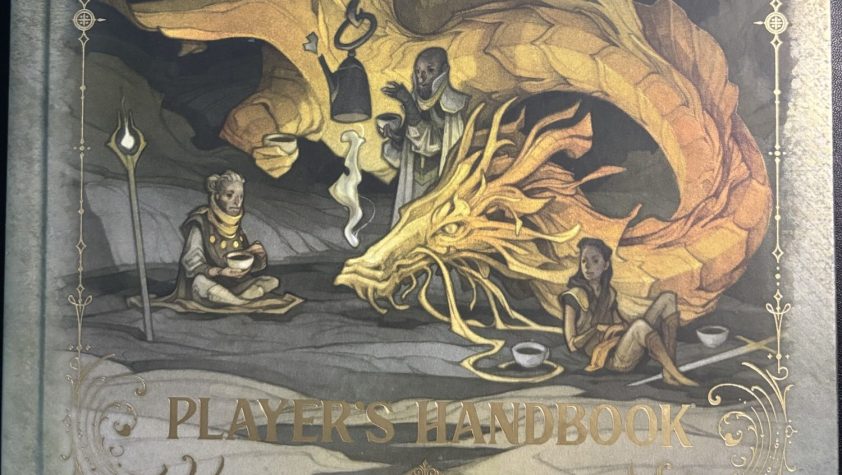
We’ve been playing with the new rules for about six months now, so it’s time to weigh in. There are many changes in the 2024 PHB update—some of them good, some of them meh, and some of them ugly.
The Good
- Exhaustion. Each level of exhaustion gives you a -2 penalty to all your d20 rolls and subtracts 5’ from your movement; 6 levels of exhaustion and you die. Simple, straightforward, easy to implement and remember.
- Surprise. If you are surprised, you have disadvantage on your Initiative roll. Again, simple and straightforward.
- The Character Sheet. Lists skills under the respective attribute, which is so much nicer for new players. I know that there’s a rule that you can Intimidate someone with Strength, or use Dexterity when it comes to the History of Juggling, but those corner cases are so rare at my table that they get used once or twice a campaign. Just total up your proficiency bonus and your attribute bonus and let go of those edge cases.
- The Price. The last PHB has a list price of $49.95. My copy of the new PHB (with the gorgeous alt cover) was $49.99. Today. Ten years and a pandemic since the last PHB was released, it’s four cents more. Four cents. Hasbro must be banking on those DnD Beyond subscriptions.
- Languages. “Common Sign Language” is on the Standard Languages list. That’s so much cooler than Thieves’ Cant.
The Meh
- Standard Array by Class. Is this necessary? Is it helpful? I’m confused by why it exists.
- Alignment. It’s still there. Would anyone have noticed if it vanished? Same with Schools of Magic. And Bloodied, though at least it’s a hook for other (third-party) abilities.
- A Balanced Party. I present exhibit A in the argument that there are really only four classes, and Bards, Druids, Monks, Paladins, Rangers, Sorcerers and Warlocks should just be subclasses. (Also, if you have a 5th player, they should clearly be a Bard.) Many games have already sorted this better, making Druids worshippers of the Old Ways; Berserkers, Martial Artists, and Archers viable fighting styles; Jack’s-of-all-Trades and Scouts types of skill-monkeys; and sorcery and diabolical pacts legitimate paths to magical power. Classes are definitely a place where D&D is hurt by the weight of its own legacy (C.F. alignment, spell slots, armor making you harder to hit, etc.)
- The Art. I was expecting more. It all looks overly-digitized and overly Marvel-ized, if that’s a thing, like it’s all concept art from the latest Paladins or Valiant release. That said, at least there are lots of skin-tones, hair-colors, and apparent ages sprinkled throughout. (Though everyone except for Leomund is distinctly toned and fit.)
- Backgrounds. I really like the “where I grew up” art pieces. But really, do we even need backgrounds? Just distribute three points among your starting attributes, pick an origin feat, two skill proficiencies, and a tool proficiency. And you start with any two weapons you are proficient with plus one batch of ammo, scale mail if you can wear medium armor, leather if you can only wear light armor, tools you are proficient with, a trinket, clothes, a couple pouches and an adventurer’s kit, and 10 gold. Done.
- No “half” measures. As in they got rid of half-elves and half-orcs. I’ve got no problem either way, though it does make it hard on people who want to switch to the new rules who are already playing one or the other.
- “New” species. I have no idea why they picked the species they did. I’d rather see Fairies, Goblins, Tabaxi, or Warforged over Aasimar and Goliaths. I never personally cared for Dragonborn, Gnomes, or Tieflings, but why not just put all the playable races in here? Why limit it at all? Add in Harengon and Minotaurs and Bugbears—make this the definitive collection for character creation. Also, if Halflings and Gnomes can be small, why can’t Goliaths be large? Is it really game-breaking? Can’t we just warn the player that they may not fit down every passage?
The Ugly
- Character creation steps. Look, D&D is one of the worst games if you come to the table with a fantasy character concept already in mind. There’s nothing more frustrating than finding out how sub-optimal your vision of Aragorn will be or that it’s pretty much impossible to create a wizard inspired by Gideon the Ninth. Want to be a bad-ass with a bow? Not the game for you. Don’t do it their way, flipping back and forth between the class chapter and the species chapter and the origin chapter. Gather your friends and make characters that would be fun to play together and that never existed before you all sat down together—not even as a glimmer of an idea in the back of your brain. Roll your attributes (4d6, discard the lowest, in order. Especially for new players, rolling for your attributes gives you the feel that you are playing a game from the outset.), pick a species, pick a background, then pick your class last. Figure out as a group what would be fun or dramatic or interesting or crazy to play together, and make those characters.
- Attributes tied to backgrounds. So we wanted people to be able to play against type, and also racial determinism is gross, so we took attributes away from species. And then we stuck them in backgrounds, so you can play a
jediwizard who started out as amoistureradish farmer, but you’ll be punished for it. I don’t understand why having a “customize your attributes” step is hard. Take three points and add them to whichever attributes you like (maximum 20). - Classes. There’s a lot wrong here that I won’t even start in on—mainly because it’s all wrapped up with D&D’s history and cultural baggage. But the biggest issues are not new to this addition.
- Why not include all the official classes and subclasses released up to now? Why limit it?
- Why is it so damn hard to make characters based on common fantasy tropes? Even for things like “Duellist” or “Fire-mage,” the obvious path is seldom the optimal path. Should a duellist be a fighter or a rogue or a bard? Or even a barbarian or a monk? Should I be a draconic sorcerer if I want to fling fire around, or actually wait, a druid, or wait, a monk? It doesn’t help that many of the subclasses (and artificers!) are missing.
- Everyone uses the same f’ing spell lists.
- Everyone can swap out their powers all the f’ing time.
- Rerolls. I hate reroll mechanics and anything else that slows…the…game…down.
- Weapon Mastery. Ugh. We were all so excited, but it just ended up being yet another option, on top of all the other options. Weapon Masteries are forgotten half the time, didn’t translate to monster stat blocks, and the ones that grant advantage or disadvantage are just better.
- Organization. Or lack thereof. Many people have commented on this, but having to look in three places in order to figure out how something like Hiding works (and as written, it still doesn’t).
In summary, as a rulebook, it’s pretty, but not super helpful during character creation nor during the game. As a new edition or revision, it lacks a clear direction, lacking a cohesive set of goals or aspirations. I couldn’t actually tell you what audience the changes were serving, but the proliferation of abilities, anything abilities, re-rolling, or swapping abilities every long rest all contribute to a slower game, and prioritize day-to-day character optimization over story or immersion.
It’s still D&D, just less so.
 The Far Reach