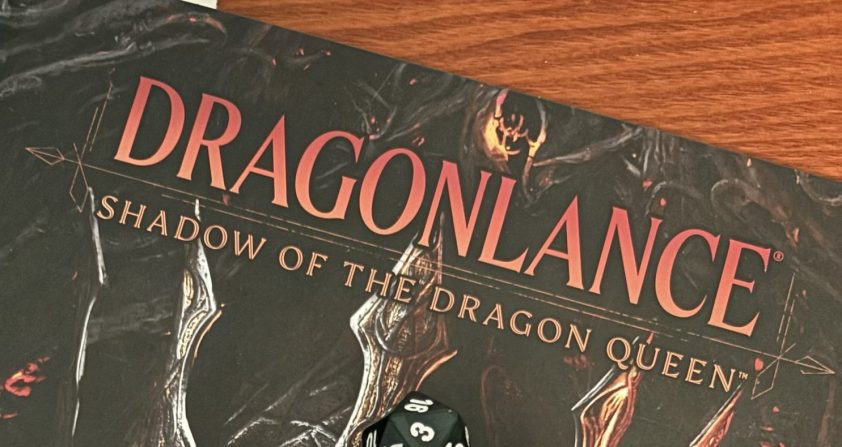
SotDQ Remix: The Goals

Here were my goals when I started the campaign:

  1. Eliminate the railroads. Give the players free reign to make their own meaningful choices and take the story wherever they want to take it.
  2. Make the war feel real.  Based on the initial reviews of the board-game, (And knowing I’d be running the game online), we decided to skip that tie-in, but I wanted to fulfill the adventure’s premise and promise of being the D&D “War Story,” and give the characters the ability to make tactical and strategic decisions. I also wanted to drive home the horrors and costs of war (especially against an enemy with air superiority).
  3. Hit the Dragonlance Highlights. For me, that includes the Towers of High Sorcery and the Test, Solamnic Knights, Kender, Tinker Gnomes, the three moons, the Cataclysm, steel pieces, and of course, dragons.

We finished SotDQ in about a year. The group wanted to continue playing their characters,  experience high-level play, and if possible, finish (and win!) the war. I took a few months off to figure out what came next, gather my resources, build out the enemy calendar and ticking clocks and the course of the war should the characters not intervene, then we got back together and set the characters loose upon the world. 

In the second half of the campaign, my goals were:

  1. Sandbox play. Open up Krynn even more, and let the characters drive the story.
  2. Put the characters in command. If they desired it, I wanted to have the option of letting the characters control some or all of the allied forces, adding a war-game component to the game.
  3. Hit more highlights. I expanded the list of Dragonlance-specific highlights to include Dargaard Keep, the Nightmare of Silvanesti, the Blood Sea of Istar, Icereach, the High Clerist’s Tower, Palanthas, the Whitestone Council, Dragonorbs, Thorbardin, the Hammer of Ergoth, the Silver Arm of Ergoth, and finally, Takhisis herself.

It was a lot of work. Hopefully some of that work will help others who want to run SotDQ or continue their campaign beyond that adventure.

About the Far Reach Remix of Dragonlance: Shadow of the Dragon Queen

Two-and-a-half years ago, my friends from my early-20s (age, not decade) gaming group (a thing that existed over 20 years ago) agreed to get back together and start playing D&D again on Sundays. And the campaign we would be starting? Dragonlance: Shadow of the Dragon Queen. 

Why would we start down a notorious railroad saved only by being a slightly less notorious railroad than the orignal DL adventures? Well, blame our middle-school selves who grew up reading the original Dragonlance Chronicles in a time just before grunge. Big hair was in, Poison rocked the airwaves, and angsty half-elves were cutting-edge fantasy. This was a time before YA novels, 3rd edition, or the internet, so yes, the idea of getting to play through the War of the Lance was too tempting to ignore.

I did what I could to remove the railroads, to give the characters meaningful choices, and to shift the plot into something that seemingly evolved naturally. Looking back, I would have done a few things differently. 

In that vein, we’re starting a series of posts on the Far Reach, which (all credit to Jason Alexander of The Alexandrian for blazing the trail), we’re calling the Far Reach Remix of Shadow of the Dragon Queen (FRR:SotDQ?). The hope is that some of this work may help other DMs who can’t escape the allure of Krynn. As always, your thoughts and feedback are welcome and valued.

Give your world-building free reign

I mentioned previously that I’m a heavy hex-crawl prepper. To be clear, I’m just in love with the world that my players and I have co-created. And so I spend a lot of time in that world, even when I’m away from the table. I’m always thinking of what’s behind the next turn or over the next rise, and when I have time, I’m closing my eyes and going to take a look.

This of course is the direct opposite of the world-building advice you hear most often: start small, and don’t spend time on areas and lore that will never come up in your game.

Fie, I say! Fie! World-building is a game and hobby unto itself, and I’m here to tell you to indulge yourself in it.

  • Imagining is good for you — According to this Mental Floss article, imagining improves cognition and self-worth, and keeps your memory healthy.
  • Creativity is good for you — It boosts your immune system, staves off dementia, and makes you happier (Forbes).
  • That last thing you created? It’s all the locals can talk about — Time to populate your rumor mill? Well wouldn’t you know it? That dungeon complex you spent three days on is the talk of the town. Maybe your characters won’t ever choose to go there, but by golly, they’ll have heard of it.

When I give my imagination free reign, I end up with an incredibly haphazard set of notes, maps, scribbles and ideas. Some areas I have envisioned in painstaking detail: I can tell you the texture of the moss on the stones in the quarry, and how it gets damper as one descends further. Other areas are just a name on a map or a blank space waiting for a name.

And that’s okay. That’s the world-building game outside the game. And when–as they will–my players set off in an unexpected direction and occasionally reach one of those spaces that I haven’t filled in yet, because I have that pile of haphazard notes, I have a vague notion of what’s there. I know that they are traveling through hilly, forested country, and if the party rides far enough West, that they’ll hit the Whiteflow, which no horse has ever forded. I know these are gnoll lands and that their matriarch has a hunger for horseflesh. So now I see the party’s horses balking at the river’s edge and the gnolls closing in with nets and spears. I can hear the barking of the hyenas. Suddenly we have an adventure!

Mix up the emotional tone of your encounters

Despite my affection for Mike Shea and the Lazy DM’s Companion, I’m a heavy hex-crawl prepper. I love world-building and map-making, but as I sketched out the locations and encounters for my campaign, I noticed that many (too many) had a melancholy or threatening tone to them, as if everything in the setting was a danger to the party, or else was an ancient ruin felled by tragedy. Part of that is just my personal preferences and thematic styling, but it also makes every encounters feel the same. And to murder a phrase, if everything is a foreboding ruin with an air of ancient grief, then nothing is. It’s just one downbeat after another, and it gets to a point where I fear my characters will say, “If this world is such a bleak hell-scape, why bother saving it?”

What I want is to enable my players to experience a wide-range of emotions as they explore and adventure, and to present them with places and people that they might feel a real affection for. Our real world is a crazy mix of encounters: scary, funny, frantic, calm; and I want that same variety and texture to exist in the world of the game.

So I’ve set out to mix up the tone and flavor of my encounters. Now, when I set about populating a location or encounter, I roll on the following table to determine the tone or the emotion that the situation “should” evoke:

Encounter Emotions (and examples):

  1. Horror/Revulsion (the tentacle leaves something behind that writhes beneath your skin, a spider crawls out of the skeleton’s eye-socket)
  2. Fear/Dread/Anticipation (a tapping on the glass of the high tower window, a mournful howl across the moors)
  3. Sorrow/Loss (a mother weeping, a farmer staring at his burned fields)
  4. Anger/Villains being villainous (a wanted poster of the party, a choice between saving the princess or saving the prince)
  5. Affection/Kindness (a child offering to share their food with a character, a strong hug from an old friend)
  6. Safety/Release (a blanket and a warm fire, a door that can be barred shut behind the party)
  7. Laughter/Delight (a parrot trained to cuss, a natural waterslide)
  8. Joy/Wonder (a field of flowers that fly when touched, the world as seen from dragon-back)

My hope is that by mixing up the emotional content of the encounters, that the scary moments hit harder, the villains seem more villainous, and the characters feel like there are areas and people who provide joy, laughter, and safety, and that are worth fighting for.

Having created the table, I also realized that much like creating random encounter tables to reflect different areas, I could tailor the emotional encounter table to different regions, helping me establish an emotional tone for a region without becoming repetitive and boring. Here are some examples:

In the Feywild:

  1. Fear/dread/anticipation
  2. Anger/villains being villainous
  3. Affection/kindness
  4. Safety/release
  5. Laughter/Delight
  6. Laughter/Delight
  7. Laughter/Delight
  8. Joy/Wonder

In the Shadowfell:

  1. Fear/dread/anticipation
  2. Sorrow/loss
  3. Sorrow/loss
  4. Sorrow/loss
  5. Anger/villains being villainous
  6. Affection/kindness
  7. Safety
  8. Wonder

In Ravenloft:

  1. Horror/revulsion
  2. Fear/dread/anticipation
  3. Fear/dread/anticipation
  4. Fear/dread/anticipation
  5. Anger/villains being villainous
  6. Wonder
  7. Affection/kindness
  8. Safety

Now, as characters travel from region to region or plane to plane, I can turn the dial so that there is more silliness or more foreboding as appropriate, and not worry that every encounter will feel the same.